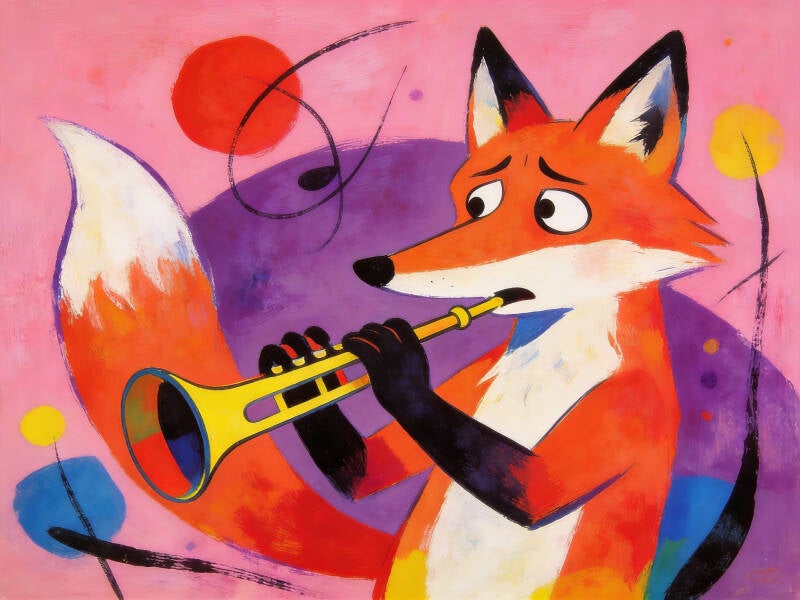
It has already been a couple of weeks since the Lower Austria Youth Symphony Orchestra performed Nikolai Rimsky-Korsakov’s Scheherazade. My daughter played the first clarinet part. The performance was a beautiful, charming rendition of this fine work, played by young musicians. Every time my daughter completed her solos during the concert, my older daughter and I delivered secret and silent claps as we gave each other knowing looks.
After the concert, my daughter asked about her performance, as it is her custom. I mentioned to her that, besides demonstrating that she is on her way to professionalism, I am very pleased about her ability to bring out her emotional depth. And, of course, she asked what I meant by 'emotional depth'. The latter was to be expected, as these are the types of conversations I have with my daughters. And how can I explain emotional depth to my eighteen-year-old, who questions everything and asks many life questions?
In simple terms, what I mean is that the performer can express their emotions through the music. My teacher encouraged me to think about something or someone special to me when I played. He would say some people think about the forest or the ocean, whatever. So that when I play, I have a story to tell and an emotion to convey, I would not feel great about playing otherwise. And to me, playing just the notes in great technical order won't bring out emotional depth. Having great technique is a tool, a means to an end. When our emotions are reflected in the music through our technical abilities, and we have something to express, it will touch the audience on a different level. And when even one person approaches me after a concert and comments that my playing resonated with them. That is a great day.
One such moment I had with my daughter was when, during one of her competitions, she was playing a slow movement from Horowitz. This was several years back, and I began tearing up because again, her expression clearly brought out her feelings and was moving.
Therefore, it is safe to say that one must feel something when they play and channel it into the music. And we should also become aware of how we express our feelings.
Another question that arises from all this discussion is: usually, the soloist is pretty much in control of how they reflect their emotions in the music during their performance. But, how do conductors do that through the orchestra, as the orchestra is the instrument of the conductor. But it comprises many players with different emotions. Therefore, where does the conductor begin, and where do the players come in?
This is where the ability and the artistry of the conductor come in. Conductors use different hand gestures to elicit the desired sounds and emotions from their orchestra musicians. They also incorporate different techniques. And to do that, they bring out their own emotional depth, along with an understanding of each piece of music and how it should be played.
And one major aspect that comes to light in this discourse is that passive playing will not in any way reflect the feelings of the player in a given piece of music. Unless the composer himself has provided directions for the player to restrain their emotions.
I believe music lovers attend concerts to be moved, entertained, and even transported into another dimension. We can be a channel for our emotional depth to shine through in our performances, and that alone is a satisfying proposition for us.
Add comment
Comments